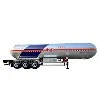
The service life of oil tankers is 10 years, but if maintenance and upkeep are not taken care of during use, they may be scrapped before 10 years. The maintenance and upkeep of oil tankers mainly include the following aspects:
1. The driving part that carries the oil tank, commonly known as the car chassis. Most drivers are quite knowledgeable in this area, but the problem is that after installing an oil pump on a tanker truck, we installed the transmission shaft and power take-off from the engine. With these two devices, we need to pay special attention during operation. Improper operation can result in the power take-off being scrapped.
2. The use and maintenance of the oil pump should be strictly carried out according to its user and maintenance manual, which is provided with the vehicle.
3. Please strictly follow the instruction manual for the use and maintenance of the fuel dispenser, which comes with the vehicle.
4. The oil output is slow and cannot be released. Please check the safety valve and filter mesh. These should be checked and cleaned regularly.
5. Oil tanks and pipeline systems should be cleaned regularly. Regularly check whether the connections of the pipeline system are well connected and sealed reliably.
6. To ensure the cleanliness of the oil tank, the oil tank and oil delivery system should be cleaned regularly, and the inner and outer joints of the oil delivery hose should be regularly coated with lubricating oil for easy and convenient disassembly and assembly. After each operation of the oil pipe, the outer end caps (plugs) of the inlet and outlet, as well as the ends of the oil hose (plugs), should be promptly covered to ensure cleanliness inside the pipe.
7. The oil loading capacity should not exceed the rated loading mass. (Converted based on oil density).
8. The medium through which the ball valve passes should not be too dirty to protect the sealing ring and improve the service life of the ball valve. Each ball valve should not work in a semi closed and semi open state for a long time, otherwise it is easy to cause the sealing ring to deteriorate. During driving, the handles of each ball valve should be in the closed state.
9. The pump inlet screen should be disassembled and cleaned regularly to prevent oil residue from blocking the filter screen and affecting the flow rate.
10. The breathing valve should be kept clean and in working condition. The spring inside the valve should not be replaced arbitrarily to avoid affecting the effectiveness of suction and discharge. When the breathing valve is blocked, there is a risk of causing deformation of the tank body.
11. In order to prevent fire accidents in oil trucks, it is not allowed to use metal objects to strike the parts of the oil truck when the exhaust pipe, muffler are damaged, the pipeline leaks oil, the conductivity is extremely bad or broken, in order to avoid sparks. Fire equipment should be prepared on the oil truck at all times.
12. If the sedimentation tank under the oil tank freezes, it should not be baked with fire. Hot steam can be used to melt it or the car can be driven into a warm room to thaw it.
13. Before operating the fuel truck, it is necessary to insert a safety pole into damp soil, and the grounding tape should be grounded. During the operation, good static conductivity should be maintained at all times.
14. Before driving, check the fire extinguisher device. Fuel truck users should be familiar with the use of the fire extinguisher and follow its instructions for inspection and maintenance.
15. Before operating an oil tanker, it is necessary to check whether the pipeline system is leaking oil, whether the grounding wire is disconnected, and whether the exhaust pipe is damaged. If any problems are found, they should be resolved first before operation.
16. When measuring oil, relevant regulations should be followed. In winter, if there is water in the self-priming pump, it must be drained completely to prevent freezing and damage to the pump body.
17. When entering the oil tank for work, attention should be paid to good ventilation, and there must be someone outside the tank for protection. If necessary, clean the tank with soapy water before proceeding with the operation.